
CD Compound Interest Calculator
Calculate the growth of your Certificate of Deposit investment
CD Investment Features
Interest is typically compounded daily and paid monthly, quarterly, or at maturity
Certificates of Deposit (CDs) are the “low-drama” part of a savings plan: fixed term, fixed rate (usually), FDIC or NCUA insurance, and straightforward growth. But “straightforward” doesn’t mean you shouldn’t model the math — tiny details like compounding frequency, APY vs nominal rate, and early-withdrawal penalties actually change outcomes more than you might expect. A CD compound interest calculator turns those details into clear numbers so you can compare offers, plan laddering strategies, and know exactly how much a CD will add to your savings.
This deep guide shows you how CD compounding works, what to watch for when using calculators, how popular competitor calculators present inputs and results, how to build your own Excel CD Compound Interest Calculator, practical laddering examples, tax and penalty considerations, and FAQs tuned to CD-savvy searches. No fluff — just the stuff you’ll actually use.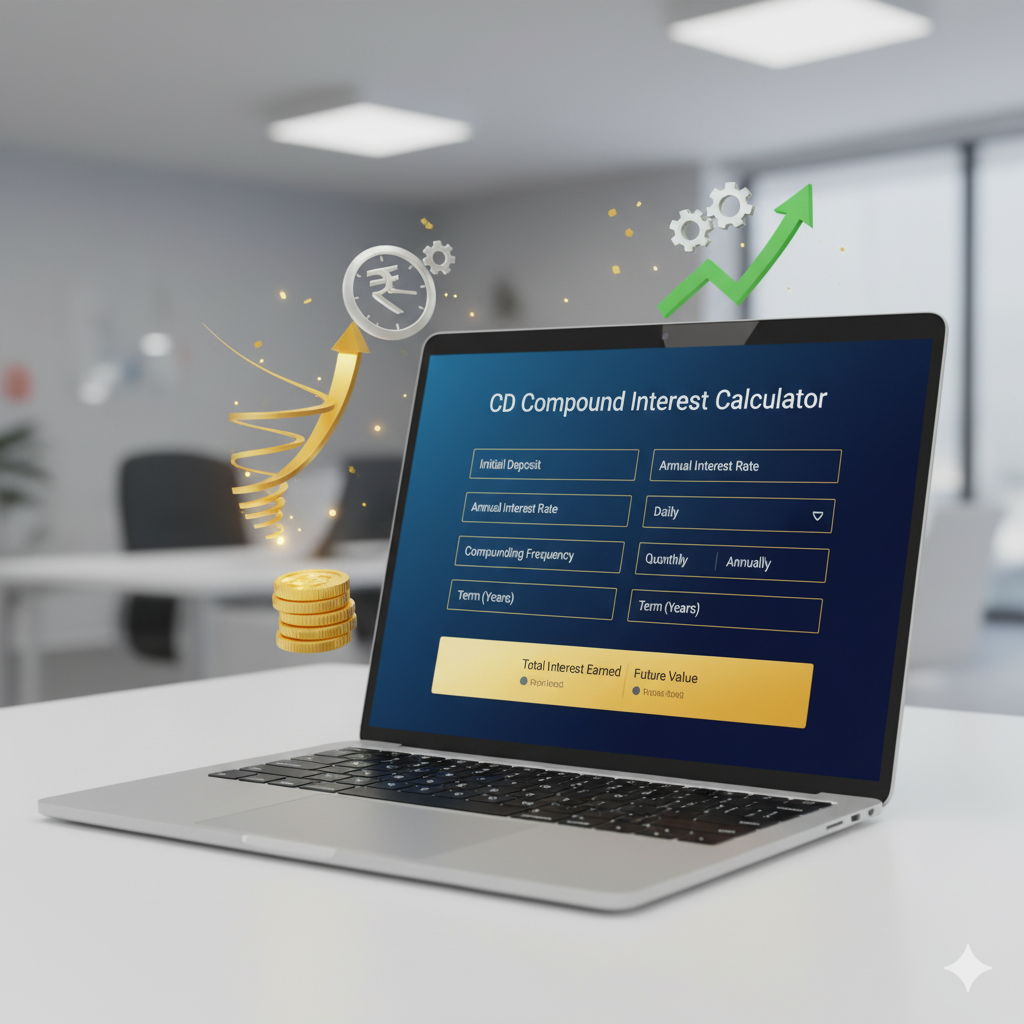
What a CD Compound Interest Calculator Does (and Why It Matters)
A CD compound interest calculator takes a few simple inputs — starting deposit, APY or interest rate, term length, and compounding frequency — and outputs the maturity amount and total interest earned. Because many banks quote APY (which already reflects compounding), calculators help you confirm apples-to-apples comparisons between institutions and term lengths.
Why use one:
- Compare two CDs with different compounding schedules.
- See the real benefit of a longer term vs. better rate.
- Model CD laddering (staggered maturities) for liquidity + yield.
- Estimate after-tax earnings if you’re in a taxable account.
Top financial sites offer CD Compound Interest Calculator to help consumers do this fast. They vary in UI and extras (some show year-by-year breakdowns, some include taxes), but all are meant to answer the same financial question: how much will my locked-in money become at maturity.
APY, Nominal Rate, and Compounding – The Core Definitions
You’ll see two commonly quoted numbers on CD pages: the interest rate (nominal rate) and the Annual Percentage Yield (APY). APY is the big one to watch because it already accounts for how often interest compounds during the year. In plain terms, APY shows the real percentage gain over one year given compounding; it’s the metric that makes different compounding frequencies comparable.
Compounding frequency (daily, monthly, or annually) matters because the more often interest is added to the balance, the faster your money grows. Many online banks and credit unions compound daily or monthly, which gives a slight edge over annual compounding for the same nominal rate. But APY usually standardizes that effect for you — always compare APYs, not just quoted nominal rates.
How CD Calculators from Competitors Usually Work (and What Inputs They Use)
Competitive CD calculators on reputable sites tend to collect the same core inputs:
- Initial deposit (principal)
- Term length (months or years)
- Interest rate or APY (some calculators accept either)
- Compounding frequency (daily, monthly, quarterly, annually)
- Taxes (optional) and whether interest is withdrawn or reinvested
Then they return: maturity date, final balance, total interest, and often a year-by-year or month-by-month growth table. Some advanced tools also let you compare multiple CDs side-by-side or include an early-withdrawal penalty simulator.
Examples: NerdWallet’s CD calculator and Bankrate’s CD calculator show how much you’ll earn and let you toggle contribution/compounding assumptions; Calculator.net offers an option to model taxes and visualize a growth chart. Those are useful starting points if you want quick numbers.
The Math the Calculator Uses – Formula and Explanation
If you want the formula behind those pretty numbers, here’s the core:
When interest compounds periodically (not continuously), the future value A after t years is:
A=P×(1+rn)nt A = P \times \left(1 + \frac{r}{n}\right)^{n t} A=P×(1+nr)nt
Where:
- P = principal (initial deposit)
- r = annual nominal interest rate (decimal)
- n = compounding periods per year (daily = 365, monthly = 12, etc.)
- t = term length in years
If the calculator accepts APY instead of nominal rate, use the APY directly with annual compounding (APY already reflects compounding). If the CD Compound Interest Calculator has periodic contributions (less common for CDs but possible for step-up products), it will also add the future value of each periodic deposit.
Most consumer CD calculators simplify by letting you enter APY and term; they compute the maturity amount directly, which is easier for quick comparisons. If you want the raw nominal rate input, select or convert it as required.
Compounding Frequency in Real CDs – What Banks Actually Do
Banks differ. Many online institutions advertise daily compounding — the interest accrues daily and is added to the principal, which then earns interest on top the next day. Others compound monthly or quarterly. The more frequent the compounding, the better for you — although APY is designed to show the final effective rate regardless of frequency. Chase, Ally, and other big banks outline their compounding practices in account terms; most CDs compound daily or monthly. If compounding frequency is omitted, ask the bank — it’s in the disclosure.
Early Withdrawal Penalties – Model Them with Your Calculator
CDs penalize early withdrawals. Penalty structures vary: some lenders charge a few months’ interest, others waive penalties during a short grace period at maturity. A good CD Compound Interest Calculator or a simple Excel model should let you simulate an early withdrawal scenario: subtract the penalty (as an interest-months-equivalent) and show the adjusted payout.
For laddering, early penalties are crucial to model: if you break an early rung, you lose yield and may even eat into principal. Always check penalty rules and add them into your model when comparing liquidity vs. yield.
Building a CD Compound Interest Calculator in Excel – Step-by-Step
Want an offline, tweakable version? Here’s a practical Excel approach.
Columns (year/month granularity):
- Period (month or year)
- Starting balance
- Interest earned that period = Starting balance × (annual rate / n)
- Ending balance = Starting balance + Interest earned
- Next period starting balance = Ending balance (unless early withdrawal or additional deposit)
For a one-off deposit with monthly compounding:
- Set n=12, monthly rate = r/12
- For each month: Interest = Balance × monthly rate; Balance += Interest
Use the built-in =FV() function for a one-shot calculation too:
=FV(rateperperiod,totalperiods,payment,−pv,0) =FV(rate_per_period, total_periods, payment, -pv, 0) =FV(rateperperiod,totalperiods,payment,−pv,0)
Example: For monthly compounding at 2% APY converted to a monthly rate, adjust accordingly. If working with APY directly and annual compounding, use annual periods.
Excel allows you to add columns for taxes and early penalty scenarios. Add a final output: maturity amount, total interest earned, and effective yield to validate results.
CD Laddering: How Calculators Help You Plan Rolling Maturities
A CD ladder staggers maturity dates (for example, 1-year, 2-year, 3-year, 4-year, 5-year). This balances liquidity and yield: you get higher longer-term rates while still having periodic access to funds. Use a CD compound interest calculator to model:
- Rung amounts (equal or unequal)
- Individual maturity balances at each rung’s term
- Reinvestment logic: when a rung matures, do you roll it to a new long-term CD or spend it?
Simulate scenario A: five equal rungs of $10k. The calculator shows year-by-year cash availability and cumulative yield. Simulate scenario B: ladder skewed toward longer rungs to prioritize yield. Compare both outcomes to decide liquidity needs.
Taxes on CD Interest – Include Them in Your Projections
Interest from CDs in taxable accounts is taxed as ordinary income in the year it’s earned (even if reinvested). Some calculators let you enter your marginal tax rate to compute after-tax earnings. Model two things:
- Pre-tax maturity amount (what the CD would pay at maturity)
- After-tax income = total interest × (1 − tax rate) (approximation; the exact tax timing matters if interest is paid periodically)
If you hold CDs in tax-advantaged accounts (IRAs, 401(k) equivalents), taxes won’t apply annually — model that separately because the after-tax benefit changes the comparative value of CDs.
Calculator sites like Calculator.net explicitly let you simulate tax drag; use that if you want realistic net returns.
Comparing Short-Term vs Long-Term CDs via Calculator
Short-term CDs (3–12 months) offer flexibility and let you chase rising rates, but rates are typically lower. Long-term CDs (3–5 years or more) generally pay more but lock you in. Use your calculator to compare:
- Scenario X: $10,000 in a 1-year CD at 1.5% vs. a 5-year CD at 3.5%
- Model both maturities and compute effective annual growth and the flexibility cost (what you lose if rates rise and you’re locked in)
Always include renewal behavior in your model: many banks auto-renew at maturity to the institution’s prevailing rate, which may be lower than promotional rates — model that path too.
Live-Rate Comparison: Why Calculators Alone Aren’t Enough
While a calculator computes math, you still need to shop for APY. Rate tables change daily; the best CD APYs may come from online banks, credit unions, or promotional offers. Use calculators to test “if I lock at X% for Y years, what happens,” then shop for the best X for your chosen Y. NerdWallet and Bankrate maintain updated lists of top CD rates; use the calculator to plug those numbers and compare projected outcomes.
Practical Examples – Run These in Any CD Calculator
Example 1 – Simple One-Off CD:
- Deposit: $25,000
- APY: 3.00%
- Term: 3 years
- Compounding: monthly Calculator result: maturity balance and total interest. Then run a version where compounding is daily to see the small difference.
Example 2 – Ladder:
- Total funds: $50,000
- Five-rung ladder: 1-2-3-4-5 years (each $10k) Run the CD Compound Interest Calculator on each rung with market APYs for the term and sum the maturity values to see total laddered result.
Example 3 – Early Withdrawal Break-Even:
- Deposit: $20k in a 5-year CD at 3.5% with early withdrawal penalty = 6 months’ interest
- Model an early break at year 3 (withdraw amount minus penalty) and compare to a 3-year CD at the then-current rate to decide which was better.
Simulate variations to learn which strategy fits your liquidity needs and yield goals.
UX Lessons from Competitor Calculators – What to Expect and What Helps
Competitor calculators (Bankrate, NerdWallet, Calculator.net) teach good UX lessons:
- Keep input fields simple: principal, APY, term.
- Offer optional advanced toggles: compounding frequency, taxes, early-withdrawal penalty.
- Provide a year-by-year table or chart so users can see growth visually.
- Allow export or copy of results so users can archive scenarios.
If you build or embed a calculator on a site, follow these UX rules to ensure users trust and understand the output.
When CDs Make Sense in a Portfolio – Calculator-Backed Rules of Thumb
- Safety + capital preservation: if you need guaranteed principal and modest yield.
- Short- to medium-term goals: CDs are great for money you can park for 1–5 years without needing access.
- Rate environment: when rates are high, locking a multi-year CD can be wise. When rates are rising quickly, prefer short-term CDs or partial laddering.
Use your calculator to quantify the trade-off between yield and liquidity. If the math shows only a minor benefit for locking long-term vs incremental renewals, prioritize flexibility.
Validating Calculator Outputs – Quick Checks
- Make sure APY vs nominal rate inputs are clear. If you enter a nominal rate when the calculator expects APY, the result will be wrong.
- Check compounding frequency units.
- Test a known example: enter a 0% rate — final balance must equal principal. Enter 100% APY for one year — final balance should double. If these sanity checks fail, the calculator’s assumptions are off.
FAQs – Focused Answers for CD Compound Interest Calculator Searches
Closing Thoughts – Calculators Turn Guesswork into Action
CDs are simple, but the smallest variables change your outcome. A CD compound interest calculator helps you choose between terms, compare offers, measure the impact of compounding frequency and penalties, and design laddering strategies with confidence. Use calculators from reputable sources to test scenarios, then shop current APYs and verify compounding terms in the account disclosure before committing.